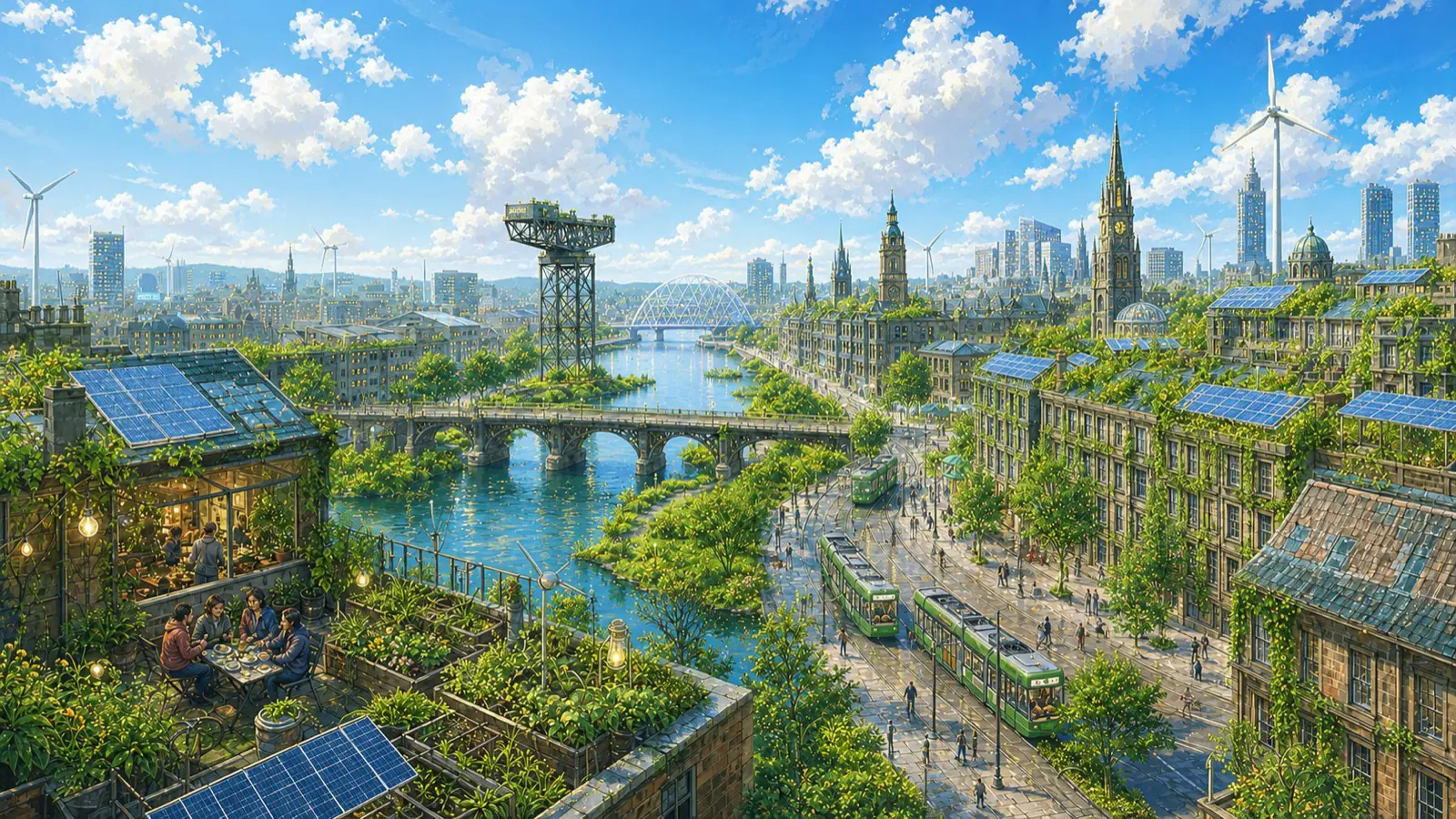
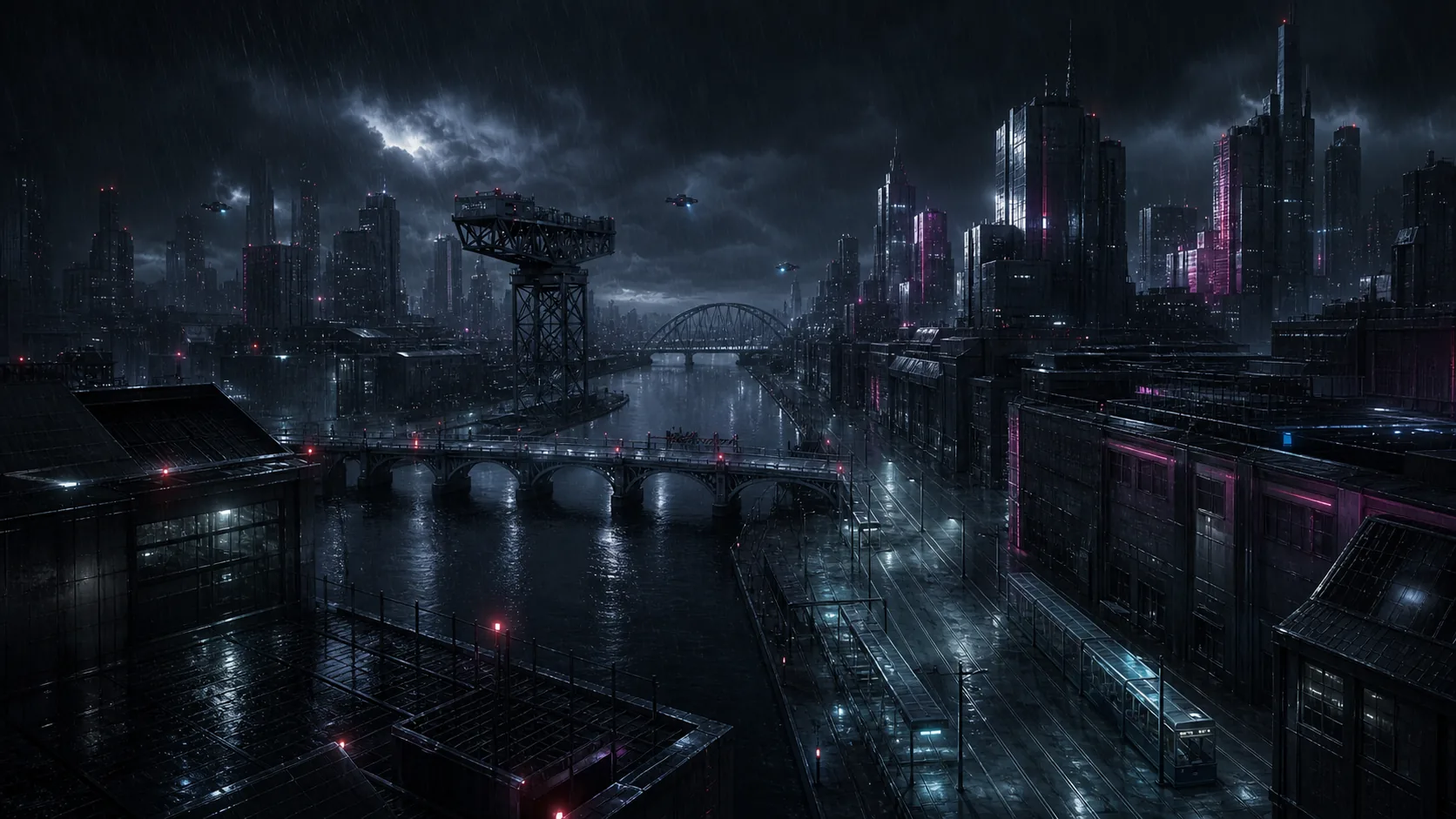
The Solarpunk Society · Part Two · Chapter 11
The 100-Year Solarpunk Plan
The ghostly ideologies of the past – whether so-called left or right – rightfully failed because they shared one catastrophic, unspoken assumption: that the Earth will infinitely supply us as we grow, exploit and abuse her motherlike kindness. The fundamental driving question of our Solartime is not, ‘How can we maximise profit?’ nor, ‘How can the proletariat take over the means of production?’ but:
How can all humanity progress alongside the rest of the planet, not against it?
The clan system that emerged after our 2018 Interdependence was impressively efficient at most things: managing day-to-day life and reorganising food systems, power, housing and council services. It put the specialist departments in the hands of specialist workers who had the knowledge from the old system and now also the power to manage their expertise – instead of answering to pig-headed politicians. The political roadblocks were gone and things were running smoother than ever. However, after the initial high wore off, the Great Clan Gathering (GCG) quickly realised we lacked a long-term plan – one that helped ensure we not only diverge from the past cult out of spite, but magnetised towards a future that could actually hold both us and the planet in the picture. We needed a unified, long-term philosophical blueprint rooted in sustainability, equity, diversity and inclusion. Fuck 5-year plans. We needed a 100-year vision!
Obviously, such a project is unthinkable under the Cyberpunk Big C Cult. Any attempt to project the cult ideologies or foundational myths a hundred years into the future could only ever create a graph that runs in one direction: off a fucking cliff. That’s why politicians like Trump rise to the surface – to keep us hyper-fixated on his daily brain diarrhea and without a second spare to focus on what icebergs actually lay ahead. Whatever you do, don’t look up!
Having identified the lack of a united future vision, the GCG immediately commissioned the Future Vision Council (don’t worry too much about remembering the name; it was only a placeholder). It wasn’t some stuffy government committee filled with hacks to confirm the GCG biases under the guise of democracy; this was a philosophical open-source hackathon with organised meetings across the country and online, inviting every citizen to join. All the usual experts where present: ecologists, international philosophers, radical economists studying alternative models – and a half-drunk dude who had his idea written on the back of a beer mat he’d saved in his inner jacket pocket since 1992. You know what? It was a half-decent idea too! Who are we to judge who is an expert, after all?
The process worked similarly to how the Icelanders re-wrote their constitution in 2010 after the banking collapse a few years earlier: brainstorming input, testing ideas and hammering out the principles of a shared future vision, all decided upon through consensus. The ideas and suggestions gathered from that process would be presented to the Great Clan Gathering, which could then decide and pass successful motions onto general referendums, adding each passed motion to our collective 100-year vision for a future Scotland. Sounds like a gargantuan project from beginning to end – but what better way to spend our time than trying to build a sustainable future that allows our children to actually inherit a living, green, gorgeous country?
Great in theory. The practice is never that straight-forward though. The clashes began right from the outset around something seemingly trivial. What do we call our new movement?
The air in the clan hall was thick. The FVC meeting was part of our national philosophical hackathon and had been going for seven gruesome hours, the whiteboard looking like a graveyard of failed political jargon with lines scoring them out one by one.
A clean-shaven man in a sharp suit – self-appointed as a rabble-rouser amidst the general exhaustion – clearly still had one foot in the nostalgic old world. He cleared his throat.
‘Ahem, we must be precise so the world knows who we are. I submit we call ourselves the New Socialist Republic of Scotland.’
There was some general applause as well as jeers for the notion. Socialism has a long history of support in Scotland.
Then a weary woman, a former teacher who maintained her iron-fisted authority, slammed the table with her hand.
‘Socialism? I worked for years under the last failed government that called itself socialist. All I got was long waiting lists, endless bureaucracy, strikes and promises that never materialised because the state was too inefficient to do anything. Socialism stinks of old Union white men, too homophobic and patriarchal to do anything truly radical.’
An old Union man shouted, looking somewhat offended, ‘Fine then! How about the Communist Collective of North Britain? It’s transparent, traditional and working-class. Long live the British worker revolution!’
He sounded like he was still living under Rule Britannia of the 1970s. There was an audible gasp from many corners of the hall at once.
‘Transparently terrrrrifying to me,’ came a sharp voice from the corner. A staunch working-class woman with an Eastern European accent spoke up, her eyes tight as she said,
‘I grew up when it was still called the CCCP.1 You want to talk about transparency? I will give a lecture right now on the actual living conditions under communism, and I prrromise you will run out of this room screaming to your union to protect you from the scourge of communism. Kurczę! Next suggestion, please.’
No one dared argue back.
‘Anarchist Association of Scotland!’ arose a young activist, face covered, dressed all in black and scrambling up onto a chair with their fist in the air.
A chorus of older, mildly tipsy Glaswegians erupted in immediate protest. One of them hollered at him, ‘Sit the fuck doon, son. You look like ye’ve squared up tae a Goth Panda and got yer arse felt. We dinnae want any fuckin’ mare anarchy in Scotland. We have enough chaos and sectarian nonsense!’
‘I’ve heard enough old white men to fall asleep, this is so boring! If we aren’t building an alternative that is deeply feminist, we aren’t doing it right. How about we call ourselves the Intersectional Feminist Front?’ came a commanding voice from a Black Scottish woman with a Fifer accent, dressed in bold purple.
Before she got the words out her mouth, of course, an angry white boy in a cheese and jizz-stained hoody interrupted her, shouting, ‘Not all men! Are you deliberately trying to make half the country feel excluded right from the get-go?’
The war of jargon and deliberate misunderstandings continued, eventually reaching such heights it mostly went over the heads of the rest of the room who fell into baffled, awkward silence.
After an all-too-painful pause, a quiet anonymous voice came from the back, finally relieving the tension, ‘Maybe we should begin by describing the old system we have escaped from. What was it, exactly?’
Without hesitation, a comic-book nerd, still huddled over their tablet, answered without raising their eyes. ‘That was Cyberpunk. That’s the definition of it, the thing we lived under before: an endless machine, corporate rule, shiny technology on the surface with surveillance, control and absolute misery underneath.’
The room processed the term.
‘Punk?’ the old Union man repeated slowly, a flicker of recognition in his eye. ‘A’ve no heard a Cyberpunk before, but I like how you put it, son. But here. Are we no still punk the noo? I mean look aroon the room and the things we are aw debatin’. This feels pretty punk to me?’
There was a general nod of agreement around the room for the first time in nearing eight hours. Leaping on the first signs of progress, Fiona with the marker pen near the whiteboard jumped in. ‘So we keep the Punk bit?’ She secretly hoped this would be the first word we wrote up that didn’t immediately need a line through it.
‘Aye!’ came the crowd reply.
‘But what do we put in front of it? Something anti-cyber, something sustainable, something... brighter?’
There was a beat of silence. Then a voice shouted out, ‘Hope!’
‘Light,’ came another response.
Then an altered echo, ‘Love.’
As if by cosmic synchronicity, at least seven people across the room, including the quiet woman from Eastern Europe and the comic book nerd, all replied at the same time, ‘Solarpunk!’
Fiona, the appointed group scribe, wrote the now immortal words on the whiteboard:
THE SOLARPUNK SOCIETY
The name suggestion now had to reach consensus – not just from the Glasgow branch, but the nationwide convention. A week later, adjacent to the Great Clan Gathering convening in the grassy lowlands just outside Stirling, we held the first national summit, pulling together all initial suggestions from the local hackathons. The conference opened with the national vote on what name to choose from each branch’s suggestions. To our surprise, ‘Solarpunk Society’ won with flying colours. It was the only suggestion that broke clean away from the jargon of the past and presented a fresh term to sum up our collective vision without any prior baggage. Given the resounding cheers when it was announced the winner, other attendees must have agreed with me. Let’s face it: you really had to be a cynical, pessimistic cunt to find anything to argue against it.
Despite the rapturous applause, there was an overwhelming urgency to hurry up and get to the much more pressing matters of the day. In these early days, as the honeymoon sheen wore off, the central problem staring back at us was, as always, the state of the economy. Get this bit wrong and the rest is damned along with it. There had been multiple signup sheets for anyone to present an idea or area of expertise they felt could help.
A young woman and former ecological researcher named Elara stood before a huge screen displaying global economic and ecological metrics.
‘We all agree that capitalism failed because it assumed the Earth’s resources were infinite,’ Elara offered the crowd. ‘And because of that naive belief in infinite growth, the system was designed to exponentially reward exploitation and destruction. Exactly like a cancer cell.’
After a pause, she turned and pointed to a data set. ‘Take the Amazon. Not the trillion-dollar digital marketplace you buy your junk from. No, the actual Amazon rainforest. Let’s say a corporation, legally or illegally, goes in, logs a patch of jungle and reports a profit of, say, fifty million pounds. In the old capitalist economics, that’s a win. As a result, GDP goes up and averages that profit out across every citizen. But in physical, planetary reality, they’ve destroyed an irreplaceable carbon sink and accelerated climate collapse while a tiny minority hoards all the profits,’ she said, air-quoting the final words with her fingers. ‘The actual monetary loss isn’t fifty million; it’s damage beyond what any amount of money could ever replace.’
The comic book geek, who had been at the same Glasgow branch meeting as me, jumped in without filter or pause. ‘The rarer a species of fish becomes, the more valuable a dead fish from that species is. It’s the extinction premium! It gets worse the deeper we go into the anthropocene. Cyberpunk capitalism incentivises the least moral and short-sighted among us to exploit nature into extinction, because the impending demise or extinction of a species or resource actually adds massive value to its exploitation. Rather than slowing down destruction, the old model speeds it up!’
Elara replied to the interjection, ‘If that economic model is judged only by the reported profits from those cruel companies without reviewing the immense and irreparable damage to the planet, it is a fictional world. Much worse than the book-keeping fantasies of the USSR.’
The core problem was now laid bare: economic values and environmental values were being treated as separate, often mortal enemies, under the old cult logic.
Fiona, the scribe, walked up to the centre to join Elara. ‘Think of our history,’ Fiona urged. ‘Like a baby in the womb, humanity’s only concern until now has been growth at all costs, even if that growth harms or threatens our mother host. We were obsessed with growth – a kind of infantial megalomania. It takes a while for an infant species to realise the world doesn’t revolve around us. Maybe here, today, is the first sign we are beginning to grow up.’
Elara bounced off Fiona’s comment. ‘Remember how Galileo was condemned and killed for heresy for proving the Earth wasn’t the centre of the universe? Our Solarpunk Society today is committing a similar heresy. We are pointing out that our economics can’t possibly revolve around just us either.’
‘I propose,’ Fiona began, rallying, ‘that from this day forward, for the Solarpunk Society and for the future of Scotland, we no longer create a separation between economics and the environment. We merge the two.’ Fiona then put the proposed term in massive letters on the screen:
ENVIRONMENTAL ECONOMICS
Later in the day, a breakaway group was formed to agree on a living definition of the term. The Solarpunk Society’s structure is democratic and open to all citizens, yet it realised not everyone could or wanted to be a part of every single decision and discussion. So, breakaway groups were essential to let smaller groups specialise, boil things down, iron out the details and bring them back to the wider collective for general agreement. There was a hierarchical structure for sure, yet the big difference is that information, power and influence flowed from the bottom to the top rather than what we are used to from classic top-down patriarchies.
The definition of environmental economics that emerged from the tasked breakaway action group was:
The non-optional fusion of planetary health (the environment) and human activity (economics)
You can’t measure one E without the other, like a pair of entangled particles. Environmental economics represents a staggering departure from the previous model which, when studied in detail, turns out to have been an elaborate piece of performance art – or possibly a joke that no one got for far too long.
The alternative to the Big C Cult wasn’t a Stalinist planned economy. It was something much more inclusive, emergent and sexier. Sustainability is sexy after all. Who wants to get jiggy with it when you think the world is about to end!? With our guiding philosophy named and its core economic principles defined, the Solarpunk Society now had its foundation to build upon. The real work – implementing the 100-year vision – had finally taken its first steps on a hundred-mile trek. The question facing us now, as we moved from the abstract to the more practical, was whether we were replacing one set of fairytale economic principles with another just as absurd.
1. USSR or Soviet Union