
The Solarpunk Society · Part Two · Chapter 12
Natural Growth and Radical Abundance
Our governments and corporations made us believe that GDP increase, or ‘economic growth’, was the bee’s knees. The thin veil of credibility that story had has fallen off. Lately, there has been a lot of talk about following the ‘degrowth’ movement and focusing on a Global Happiness Index instead of GDP. I love most of what these ideas stand for, but here’s why our Solarpunk society hasn’t aligned itself with them.
A Global Happiness Index (GHI) sounds like a banger, right? The idea of measuring a society’s progress on the collective happiness of its citizens rather than their productive output is a beautiful one, famously pioneered by Bhutan. In 1972, the teenage King of Bhutan found himself cornered at Mumbai (then Bombay) airport by Indian journalists essentially asking, ‘So, your country is tiny, isolated and landlocked – what exactly is your Gross National Product?’
It was one of those attempted ‘gotcha’ moments designed to highlight Bhutan’s lack of industrial muscle, but the young king looked them in the eye and deadpan responded: ‘Gross National Happiness is more important than Gross National Product’ – or something to that effect.
This off-the-top-of-the-head, quick-witted mic drop is the origin of the Index, not the result of decades of research by some academic committee. What started as a clever bit of footwork to dodge an awkward economic question ended up accidentally founding a global movement. Whatever its origins, it has inspired millions as a galvanising idea that focuses the attention on our humanity rather than productivity. But Bhutan is no utopia.
Bhutanese are still treated as subjects of a ruler rather than free citizens. Is it possible to be truly happy living under an extreme hierarchy? Happiness is notoriously slippery to measure anyway. Countries like Norway are often ranked as some of the ‘happiest’ in the world, yet they simultaneously grapple with some of the highest rates of loneliness and suicide – details often lost in overly abstracted data points. So what are we actually measuring when we say ‘overall happiness’? Material needs met? Hedonistic attainment? Spiritual enlightenment? Everyone has a different answer, so it seems.
Is it even all that bad to not be happy all the time? As a singular metric, happiness alone can be manipulated to excuse terrible things. It’s possible to imagine a population very happy, drugged on some chemical and trapped inside a VR-induced simulation while they are harvested for their energy like is the case in The Matrix. Or maybe the planetary water levels rise all around them while they are blissed out, only realising the cost of their happiness once it’s too late and they are suddenly drowning. There are many more dangerous ethical rabbit holes: the all-out political attack on the trans community or the ethnic cleansing of an ‘undesirable’ community could all be framed by bad actors as a way to increase overall happiness – just as politicians currently manipulate markets in every way they can in pursuit of gaming the graphs. A GHI could become a powerful tool for population control and social conditioning: toxic positivity on a nationwide level. Ultimately, as a stand-alone yardstick, GHI is just not good enough.
Degrowth is another term doing the rounds here in Cybertime these days. But from a marketing perspective, ‘degrowth’ is just a straight-up dogshit name. No one is getting wet about the lips thinking about DEGROWTH. The problem with it is less to do with the agenda it puts forward and more to do with the fact that it is a name based on a negation. It sounds like a lacking – like there will be less for me and you – when, in reality, it is arguing the exact opposite. No one can make a mass movement around degrowth because of our conditioning.
What does it actually mean though, if you push past its branding? Degrowth illuminates the collective hypnosis of capitalism – the foundational myth that GDP is always a net benefit to every citizen – when in fact, we know by now it’s often the opposite. Capitalist growth in 2025 usually means someone has managed to enclose and sell a once free or cheaper product or service, manufacturing a false scarcity around it for a higher profit. When a health insurance company is inclined to be less deceitful to its customers (for example, because one of their CEOs got shot to death), it can and will literally be sued by its own shareholders for failing its LEGAL responsibility to maximise profits, even if those profits are made at the expense of severely sick and dying people. In the case of US health insurers, profit growth for anonymous shareholders is vastly more important than the lives of literally millions of US citizens they are supposedly in the business of keeping healthy. This is not health insurance, it is a private sickness tax. These horrible examples exist more than ever today when we look around, but surely GDP growth wasn’t always a bad thing for the common person?
For decades after WWII, GDP growth was actually pretty closely tied to rising average incomes and shared prosperity across Western societies. But around the 1980s, these trends diverged sharply. While GDP has continued to grow, the benefits have been concentrated almost exclusively at the very top of the pyramid. So, the problem is not necessarily inherent in GDP growth itself. The issue, as always, is inequality. Whose interests are taken into consideration when chasing profits and who benefits from those profits? GDP measurements conveniently do not ask these questions.
The post-war social contract used to include a small but noticeable slice of the profits pie going to support emerging middle classes. Yet even they have increasingly been cut out of the equation. Workers were never considered when dividing the shares – and the planet we pillaged in the first place, even less so.
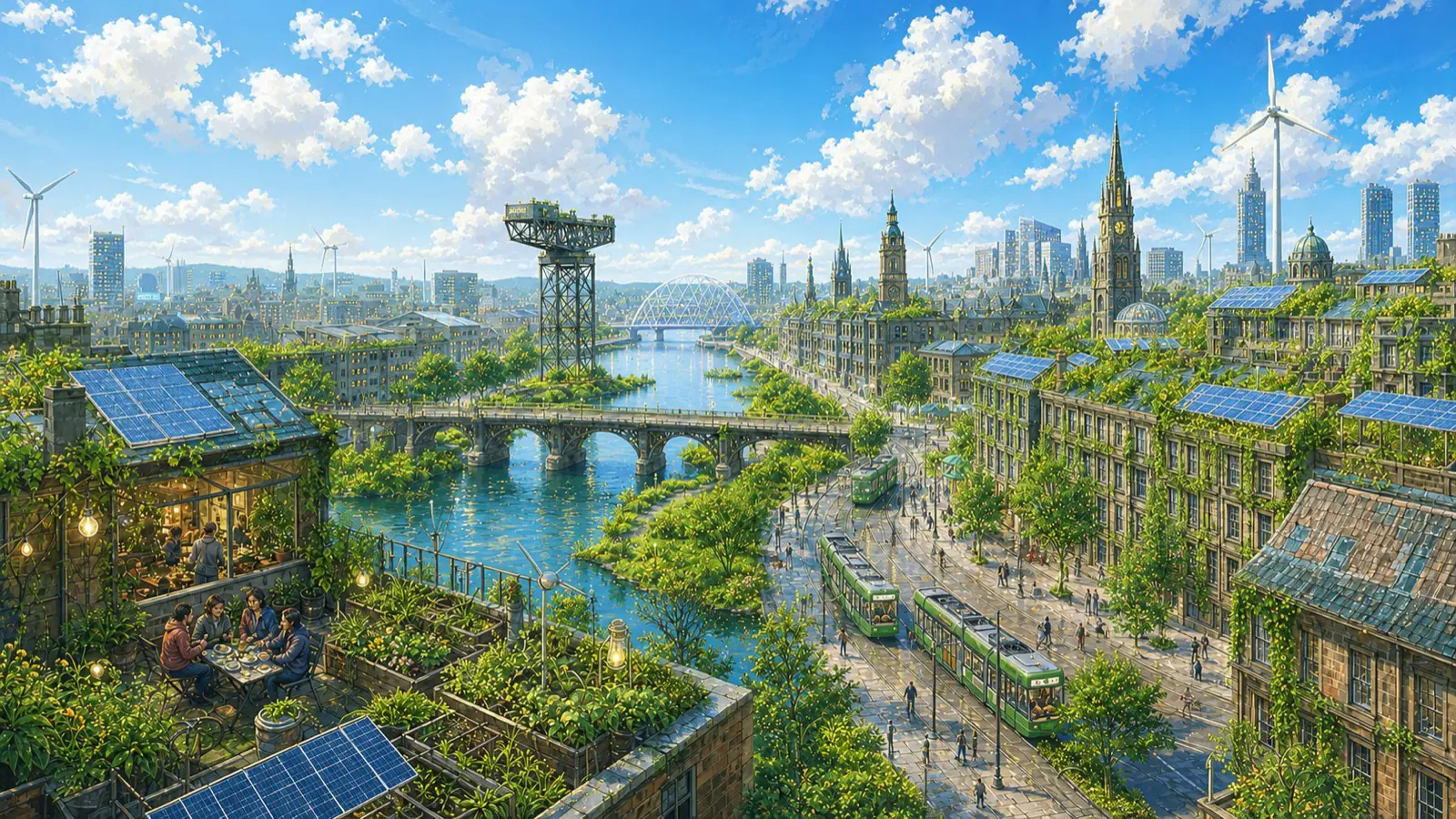
Rather than abandoning GDP growth altogether, in Solartime, we called for a realignment – a realignment between human, technological and planetary needs. We argued that growth should benefit not only human society but the rest of nature, too. Incentivising fishermen to collect and sell waste plastic at sea with funding to kickstart it all, for example, created whole new, innovative industries around it – like autonomous aquatic mushroom farming. These industries all led to a growth in GDP, and everyone, including nature, was better off because of it. In the same way the late-stage disaster capitalist cult has managed to monetise human misery, we set out to monetise happiness, harmony and the restoration of the commons. One way we did that was by investing in decentralised, community-owned renewable energy grids. They made our society less beholden to mega evil corps as well as dictators of foreign petrostates like Russia, the US or the Saudis and increased GDP through an expansion of citizen power and wealth. This investment in citizens’ time, safety and creativity led to a much greater ROI than whatever crumbs we got in taxes from the old energy dinosaurs,1 which did see a vast reduction in profits. Overall, this meant GDP went up because everyone was wealthier – not just a few CEOs.
As we built new hemp and weed farms and invested in psychedelic research, we saw a massive boom in both scientific and industrial investments, as well as many new conscious travellers visiting Scotland – for the wild mountains and even wilder guided mushroom trips. This drastically increased our GDP while having a net benefit to the people involved as well as the environment, as eco-tourist companies were incentivised to keep the place tidy and something to be proud of. So far, over in Solartime, we have managed to meet our environmental targets while continuing to grow the economy – simply by seeing these goals as the same challenge, rather than opposing ones. Growth is not our enemy nor is population increase or decrease, so long as we take into account the wider ecosystem we are growing into.
We are not technophobic back-to-the land peasants. Our innovation-driven GDP, every year for the past five years, has outstripped many previous highs. Previously underfunded and abandoned towns are flourishing as they are reclaimed and, at the same time, Scotland has seen the largest programme of rewilding in Europe. We are by far the most carbon negative country, and our waters are safe havens for long depleted fish to finally begin to heal and replenish. In environmental economics, this is called natural growth, as opposed to infinite growth under capitalism.
Sounds too good to be true again, doesn’t it? All this natural growth stuff. We are so trained to think that the way it happened before is the only way it can possibly happen again. The human creative mind is a prisoner of its own imprints from the past, so it seems.
As Jason Hickel points out in his epic book Less is More, if capitalism is defined by the manufacturing of false scarcity, waste and fear, then the opposite system is less about degrowth and more about building an economic model of RADICAL ABUNDANCE. Now, that is much better branding. That is a movement I could get behind and fight for!
I already listed some of our good early wins over in Solartime, finding technological and economic niches that could exist in the Venn diagram between human and environmental needs. But I would be dishonest if I claimed that was a sufficient response to one of the greatest dragons in economic theory: the belief in infinite growth. Although no classical Cybertime economist is dumb enough to say it out loud, this is the real foundation of the Big C Cult.
The Solarpunk alternative to infinite growth I’ve presented so far is incomplete if all it’s saying is, ‘Don’t worry, we can just have infinite GREEN growth instead!’. Even if an alternative energy source to oil was 90% greener, let’s say, it would still eventually eat up the planet, if only a bit slower. Economic productivity – even if it’s greener in comparison – left unchecked, will eventually consume the entire planetary resources. On a very finite planet, the problem obviously isn’t the word ‘growth’; it’s the word ‘infinite’.
The current Cybertime solution is simply expanding wasteful consumerism onto asteroids and into the cosmos. First off, the people striving for that are far too dumb and egotistical to successfully pull off even the first stages of complexity needed for such a venture (see Elon’s expensive SpaceX fireworks). Secondly, is that really our future as humanity? Mindlessly expanding across the solar system, violently consuming everything we touch like the Vogon, Daleks or some amorphous floating space cancer?
I want us to explore space but maybe there are higher intelligences out there that will only tolerate us when we are ready to explore with kinder intentions?
Billionaire space-dystopia fantasies aside, if we don’t fundamentally factor in various growth and death cycles in our economic models as a feature rather than a bug back here on Earth, we’re just postulating distracting nonsense on a boat about to go over the edge of a waterfall.
We had to start by not only designing our new spaces as circles but imagining our entire economy in cycles. The economy had to refocus from a linear build-to-break consumerism to a circular mend-modulate-and-repair communitarianism.
That didn’t mean people stopped buying things. It just meant things were used and reused around the economy much more than before. This opened up space for technological development that doesn’t primarily focus on massive ROIs for vulture investors from selling brand-new items we don’t need that break within a week. Instead, in Solartime, we build long-life tech that can be repaired or upgraded modularly. There has been an exponential increase in R&D into recycled organic materials and new tech that can efficiently and autonomously harvest useful metals and materials from products at the end of their life cycles. It’s peak alchemy: turning throwaways full of precious metals into gold bars.
Every revolution in history has led to the rise of a new class of self-appointed pricks. History shows us that if we leave societal decision-making to corrupt governments, corporations, kings or queens, all our sacrifices will only ever buy us moments of temporary reprieve between one fascist we depose and the next bureaucratic wolf in sheep’s clothing that replaces them. At the same time, a political or social movement led by people who are fundamentally skint is a toothless tiger. In Solartime, we had to redirect the flow of wealth, investing and subsidising our way out of crisis. But unlike during COVID or the recent energy shocks – where chunks of tax-paid government funds were blindly handed over to pharmaceuticals, banks and oil companies – we invested it directly in the people themselves.
It’s hard to see how deep you are buried within a cult when no light penetrates from the outside. Eventually, the walls vanish altogether until it feels as though this is all there is, your entire universe shrinking down to a pinpoint. Or, if you do catch a glimpse of something beyond, all you hear about are even more violent and punitive alternatives than the reality you’re in – as if the only option is to escape Fritzl’s basement for Manson’s bunker. Fuck that for a choice!
On the one hand, I might not be best placed trying to show you there really is light beyond the walls, given I have no background in maths or economics. But through some quantum fate, I’m the daft cunt that’s stuck here with you in Cybertime. On the other hand, it is probably a good thing I’m not an economist. When was the last time you kept your eyes open listening to a classical economist for more than five seconds before you thought to yourself, I hope he doesn’t make love to his partner with that voice.
As you can imagine, I had some initial resistance to writing this part. I’m like the dude who returns to Plato’s Cave trying to explain to the inhabitants staring at shadows cast by puppets on the wall that this is all just a cave, and there is a whole three-dimensional world out there. The problem is, we don’t really have the shared language for what exists outside the cave in the light. So, forgive me while I try to explain, to the best of my abilities, what a world outside the cult walls looks like.
I was a bit reluctant to write this part and open the Pandora’s box of Solartime economics, for fear of stepping into a hyper-intellectualised, jargonistic world that could either make you think I’m an idiot or, equally as bad, a boring cunt – or worse still: both! But if I were to brush over or ignore the economics of a Solarpunk world, I’d be missing out on its most vital organs: the beating heart that drives our gorgeous new planetary model – a model we have all the tools to build here in Cybertime too, should we wish to.
Let’s break down some classic ponzi banking basics, so we can agree what we are up against here before exploring what the alternatives might be. In Cybertime, the rich have a stealth weapon against the poor: inflation. Everyone has heard of it, but few of us have a scooby what it actually means. At its core, inflation is a flat tax on everyone. Each year, central banks and governments devalue currency, effectively taking 1-5% of every person’s unspent income without consent. Your bank account balance might have stayed the same, but its purchasing power diminished. The only way to escape this is to have enough wealth to move your money into ‘investments’ that will outpace this quiet erosion of savings. For the poor who have little to save and nothing to invest, inflation acts as a poverty tax. It penalises people for being poor. This deliberate devaluing of citizen savings to pay for foreign wars is starting to sound awfully like those bastard Romans again.
We also have to confront the myth of what we think a bank is. Most of us believe banks are a simple storage service: a safe place to keep our money. They aren’t simple and they don’t store your money for you. They take your deposits and invest them as their capital into all sorts of dodgy shit – from weapons manufacturing to surveillance tech and AI. If they make a profit with your money, they keep all of it. If they lose your money, they just hope you don’t notice. If you were to ask for all of your money back at once and the bank had spent it on these gambles, they would take it from your neighbour’s account to pay you. But what happens when you and your neighbour want it out at the same time? What if everyone asked for their money back at the same time? That is called a bank run. As proof that the bank doesn’t store your money but spends it however it wishes, every historical run has collapsed the bank, leaving customers out to dry or, if they’re lucky, partially bailed out by taxpayers. In other words, workers of the world loan their meager wages each month to a shady bank that gambles with it, investing in awful shit and, when it loses, the same taxpayer has to bail them out. The entire system is a house of cards, a violent Ponzi scheme built on manipulating the trust of its users. If we all lose faith in the banks tomorrow and demand our money back, the entire system would collapse. It might feel satisfying to imagine such a collapse but in reality, it would immediately trigger a mass land and asset grab by those same thieving banks – which is exactly what happened in 2007 and 2008. Banks facing collapse foreclosed on almost all their middle-class mortgages,2 deliberately forcing millions of mortgage defaults and forced sell-offs. This was particularly prevalent among Black communities in the US – a country that has forever been deeply afraid of the idea of Black people owning property or the means of production like their white counterparts.
Now, most rental properties in the UK, for example, are owned by US investment banks as a result of these land grabs. What an entirely broken system, where the banks win if they profit and still win when they lose. It’s a multi-level scam, held together by creating an ever larger scam on top of it. None of this even touches upon the ultimate scam of how banks actually create new money in the first place. We can come back to that later.3
In Solartime, we chose to build something different. As is the Solarpunk way, we started out using the economic tools that were around, only repurposed with a different motivation and incentive structure (which we will go over throughout the next chapters). Once we brought this new framework into our society, something truly remarkable began to happen: Money simply stopped mattering as much as it used to. It was no longer a key identifier of success or the primary driver of human life. We kept a concept of money to help us trade and live, but paying off debts was no longer the sole reason to get out of bed. The change was so gradual and seamless that almost none of us noticed our relationship with money change. But once our human souls were lifted from the constant state of paranoia and scarcity, allowed to return to a place of love and trust, money – the very thing so many used to pray for or try to ‘manifest’ – became an afterthought; a simple means rather than the ends in itself. Instead of scarcity, in Solartime, we mostly focused on the new connections that were coming into our lives. People began helping, gifting and serving one another – for free mostly and not because the state mandated it, but because they realised it felt good and was in their economic self-interest being both giver and receiver.
What better starting point than the currency itself for me to kick off explaining how we built our Solartime environmental economics of abundance.
1. Sometimes, in countries so deeply bought and sold like the UK or Australia, governments would even give more in subsidies to oil, gas and mining companies than they receive back in taxes – despite those companies reporting bumper billions in profits for shareholders. Madness!
2. You don’t buy a house with a mortgage – in reality, it belongs to the bank until you pay it off, which nowadays might never happen. You are still a renter, except off of the bank rather than a landlord. Mortgage, by the way, comes from the French word for ‘death’ and ‘pledge’. Make of that what you will...
3. David Graeber gives a deep dive into the history of banking and debt in his book Debt - The First 5.000 Years.