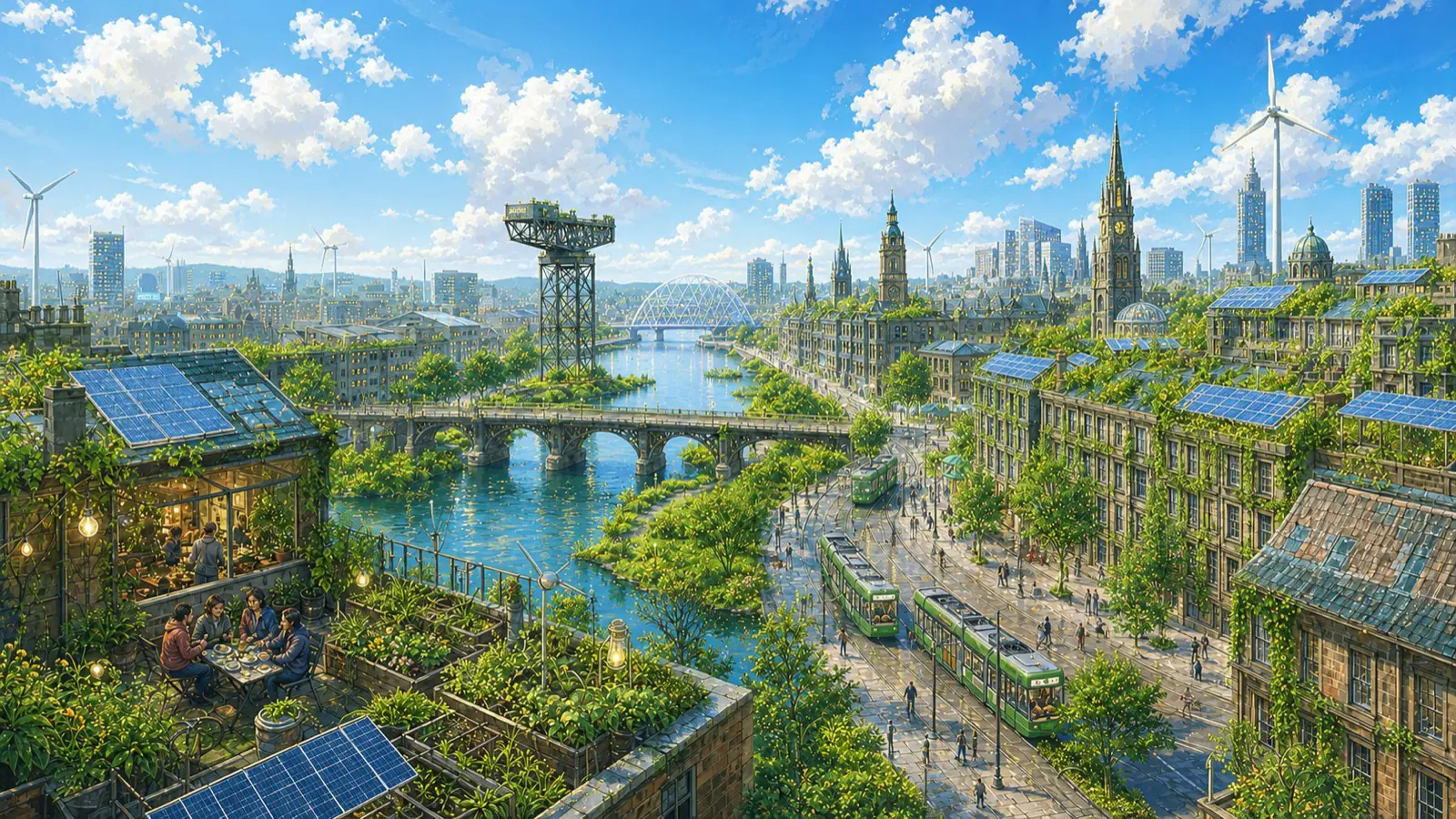

The Solarpunk Society · Part Three · Chapter 29
The Wild Within Us
Rewilding is an awesome word but when it comes to a national policy and framework – what does it actually mean? The goal was never to turn Scotland into some safari park or curated ‘nature experience’ for tourists and kids on a school trip. Nor did rewilding mean building a nationwide botanical prison with exotic displays, Latin labels and signs on perfectly mowed grass saying ‘Don’t Touch’. What we meant by rewilding was true reintegration: folk, foxes and fungi back in the same messy yet interconnected system.
How the hell could we even begin such an ambition after thousands of years of enclosure? We decided to start with the corridors. Simple idea – maybe even too simple: stitch every last remaining scrap of green together. Parks to riverbanks. Brownfields to birch woods. Instead of shoving ‘nature’ in a box marked ‘weekend visit’, we encouraged it to creep back through the cracks and breathe again as one joined-up organism – one where all plants and animals could explore and coexist. The point wasn’t to keep humans out. It was to gently erase the line that said we weren’t part of it.
It worked pretty well, at first. Wild flowers burst out of railway verges like they’d been waiting on the go-signal. Species of bees and birds long gone started to reappear. Country foxes and deer followed the greenways through town squares – not searching for half-eaten sausage rolls and pizza boxes but because the greenways started to resemble their home too. RAFI even found a hedgehog family snuggling in the solar battery shed he built behind the Govan grow co-op. ELI near broke down greetin’ when a colony of bees turned her compost loo chimney into their massive hive. ‘It’s like they picked me, man,’ she sobbed.
KEENA just snorted, ‘How did you convince them your shit smells like roses?’
For a while, it was magic. The cities were learning to breathe again and the countryside was no longer the scene of some Watership Down genocide. But somehow, we still fucked it. We went too far too fast without considering all elements of a biosphere. With hindsight, we spent too much time focused on the cute ones: rabbits, deer, beavers even – you know, the fairytale storybook crew; the ones your granny stitched onto tea towels. We left the extinct predators out of the plan. Folk were too entranced trying to film red squirrels doing parkour across grassed rooftops when the imbalance crept in. Indigenous tree saplings were constantly stripped bare no matter how many we planted. Wetlands were trampled into mud soup, killing off ground nesting bird species. Whole nature nurseries munched for a buffet breakfast by moles, voles, rabbits and deer, who had no natural predators to give them any sense of caution or restraint. The issue is that an exploding population of herbivores without sufficient predation will sooner or later lead to the decimation of all vegetation, crops and trees. This, in turn, can lead to mass famine and population collapse. If your goal is the reforestation and restoration of the temperate rainforests, good luck getting anything off the ground with a million munchied herbivores roaming around freely. A vegan animal rights-based approach does not give us an easy solution to this problem. What do we do when the individual needs and rights of those newly populated animals are at odds with the ecosystem we and they depend upon to live?
The old aristocratic hunting estates were largely going extinct in Scotland after our land tax changes, often transformed into various forms of community rewilding projects. So to manage the new green corridors and the exploding animal populations eating all the plants and trees, we hired many of the old estate groundskeepers: humans with experience of handling rifles. Not hunters of course. Oh no, we dressed them up as ‘ecosystem technicians’, trained and accountable – or so the naive Solarpunk Society suggested in their early recommendations. These new biosphere employees gathered data on apps and clipboards, used biodegradable ammunition and followed a strict ban on profiting from, or having any conflicts of interest regarding, the necessary kills. But still: we had somehow ended up back at humans with guns calling the shots on who should live and who should die. We convinced ourselves it was better this way – that it would minimise unnecessary suffering, keeping it ‘humane’ and transparent, showing the world that we Solarpunks could ‘manage’ ecosystems better than the old aristocrats ever had. Truth is, it was mostly hubris.
Humans roaming around with guns trying to control the natural breath we were simultaneously trying to liberate was always going to lead to tragedy eventually. It still breaks my heart, though, that that tragedy had to happen to Corey McNiven. Twelve years old, playing in the forests behind his new family home, it was a classic case of wrong place, wrong angle, wrong clothes even. He blended into the gorse and moss just like a stag. It was a particularly problematic area with far too many deer. Kill quotas had been agreed upon by the local clan. One technician’s itchy finger – maybe from too much coffee or not enough – on a mission to meet his daily quota and get home early, fired a single reactive shot and that was that. No more Corey. He was born a city kid who had moved out to a new eco-community with his single mum to start over after her troublesome breakup. Corey was obsessed with goats, always showing off the wee billy he trained to follow him and sit on command like a dog. We all watched the live scenes of his pet goat crying and searching for Corey in those woods. It didn’t matter how rare an incident it was or how many safety reports came out after. An innocent kid was now dead, all in the name of trying to rebalance a system we had created. The ensuing public debate ripped the country in two and the Solarpunk Society, which hosted and held space for the debates, really felt the pressure – pushing it to the breaking point as extreme emotions flared up and fighting broke out.
One side – the side I agreed with at the time – said this proves we need the real predators back. Wolves, lynx and bears not in zoos or safaris, but back out there in their natural habitat; the way it was meant to be without human micromanagement. Let the wild handle its own balance without our arrogance and guns in the way.
The other side dug in harder, especially some of the new homesteaders now living in the reintegrated natural spaces where humans and wildlife roamed free. These are the folks who had finally escaped the cities, built their Earthships, planted their gardens and got their chickens, but were still struggling to figure out how to make it all work sustainably and safely. It was bad enough with foxes threatening their chickens. They sure as fuck didn’t want a big bad wolf sniffing round, eating their young children. Telegram groups filled with dead lamb rumours from abroad where predators had been reintroduced and a shaky drone clip that might’ve been a lynx, possibly a stray dog or simply a bin bag. It didn’t matter. Fear travels faster than facts. The arguments filtered up through the local clans and hit the Great Clan Gathering like a storm. It nearly broke our consensus models altogether. In the end, after months of national debates, petitions and midnight sessions, a final consensus was made by the GCG and a third attempt at a public referendum finally passed. It was one of the most controversial ones so far. It was a plan for trial reintroductions in specific areas at first, strictly monitored by scientists with each biosphere responsible for their own adoption strategy and timeline. It was the hardest decision our new society ever faced to date. Me and LOFI had stood up at our local meetings, trying to cool the panic, saying things like: ‘Look, predators aren’t the problem. Predators are the repair.’
‘Real wildlife has teeth, aye, but that’s the point. You can’t declaw a truly wild forest.’
‘Those predators would have no reason to see us as enemies or potential food, especially given that we are reintroducing them into an environment swimming in prey, much easier and tastier than us.’
The scientists on the whole backed us up with evidence from places like Yellowstone National Park. Reintroduced wolves stuck to eating deer rather than tourists, and lynx patrolled the isolated hills rather than hen houses, much more scared of the humans than the humans were of them. More importantly, there, a small amount of predators had a huge effect on the herbivores. Deer in particular started hiding in established forests rather than out in the open. This allowed vegetation to regrow on barren valleys and hillsides much faster. As the programme rolled out nationwide, early reports said livestock losses were tiny and human casualties were zero. On paper, it was all working as predicted and the storm pretty much came to pass.
Until Pickles disappeared. Our wee rescue cat – three legs and deaf in one ear – had survived starvation, eviction vans, pandemics and probing from for-profit vets. He was the toughest bastard I ever knew. Then, one night, he was gone. In my slumber, I thought I heard a short scream out back, then silence. I searched for hours. I couldn’t sleep properly for nights after, imagining every sound would be him hopping back in the window. To this day, I don’t exactly know the fate of Pickles. It could’ve been anything really: a car, a fall, some feral dog. Maybe he found someone with better cat food (although that’s unlikely because LOFI used to cook for him). My gut fear told me it was one of the new lynx and, for the first time, I felt what the homesteaders were feeling and maybe the deer too – that gut-sick panic that something toothier than you might be waiting just beyond the fence. I imagined we had young kids playing in the garden that evening…
The cognitive dissonance of it all fucked me up. My head said, ‘Trust the scientific evidence, it’s working,’ while my gut said, ‘The rumours, those CCTV videos, they might all be true. Some bastard ate Pickles.’
For a while, I even joined those threads I used to mock, scrolling the dubiously blurry photos like a ghost hunter in an abandoned mansion, endlessly ruminating on the fear. The irony wasn’t lost on me. I’d campaigned for years to let the wild back in and maybe it had just taken my favourite cat pal back with it. Logic, in this scenario, doesn’t matter. The fear was real and overwhelming, and fear is the one thing that doesn’t need evidence.
So here we are, in today’s Solartime Scotland. Autonomous ecosystems across the country are trying various methods. Some regions went all in with small packs of wolves roaming Glen Affric – not loads, but enough that the deer pay attention. The rivers themselves already looked different, thanks to new tree root systems redirecting them – roots holding banks steady, soil staying put. Other bio-regions built integration fences, patrols and buffer zones. Some bright sparks even pitched Wolf National Parks with visiting hours – a human-wild hybrid incentivising harmony through education and tourism, so locals could make money through rewilding rather than play victim to it. The wilderness educators, too, got busy across Scotland with Forest Schools teaching kids to track pawprints instead of Pokémon. Some rescued cubs were raised in forests alongside our own kids’ outdoor classrooms – young human and wolf rewilded together, raising a new generation who saw each other as kin and peers.
But no solution fits everywhere. And no experiment is final. There are still long-standing, deep, raw wounds for the animals, the forests and us humans – beginning to scab over in some places, still bleeding in others. We don’t get to draw a map of nature and scrub out the parts of the ecosystem we call monsters. If we call the wild home again, we’ve got to live with its teeth, too.
If only the complications ended there, we would be living in a paradise. See, once we started rewilding in earnest – not just chucking wildflower seeds at roundabouts but tearing up and replanting Trump golf courses, bracken-deserts and monocropped wastelands – we ran into a thorny existential question: What land should be repurposed for food and what land was to be for freedom? Could there ever really be land enough for both?
We had this dream that we could create a patchwork of small-scale, family-run organic farms across the country that would provide enough food for everyone. Earthship homes nestled between forest glades or people living up in the trees themselves. Food forests integrated with inner-city schemes. Free community chickens wandering about, named after philosophers and poets. Every community baking its own local bread in huge communal ovens, radish gin distilleries springing up and wild mushrooms propagated and harvested omnipresently. Ideas that were all romantic as fuck.
We knew the well-documented problems of the cult we were escaping with its industrialised farming. It kills everything it touches, removing the nutrients from the soil, eradicating in years what takes centuries to recover, poisoning the food supply and handing over control to US mega-corporations – like Monsanto with their patented seeds farmers are legally banned from saving. The biggest pain in the tits with our alternatives, though – as gorgeous as small subsistence organic farms are, low-impact and chemical-free – was that they’re really fucking low-yield in comparison. Even with permaculture wizardry and Solarpunk tech pumping up long-term production, in the short-term at least, they couldn’t create the calories per acre that those awful mechanised mega-farms could. This problem was magnified further since we also intended to rewild half of Scotland at the same time. You want Bhutan’s organic purism and the Netherlands’ food output, all while living in a rewilded haven for all beings? You’ll break the laws of physics – or at least the ones governing our tech as we know it today. It turns out that, when you rapidly shrink industrial-scale farming and give back land to the wolves, boars and blooming grasslands, you end up in a tight spot – unless you’re ready to either starve, reduce the population massively or rely on imports that put you right back in the coloniser-consumer trap.
It didn’t take long for the ideological backlash to break out in the Solarpunk Society debates. On one side were the purists, saying, ‘If the soil’s dead, the food’s dead. Chemical fertilisers are carcinogenic and masses of food with no nutritional value is useless. Industrial agriculture is a war crime against small farmers and the land, just with a good PR team.’ On the other were the pragmatists, countering, ‘Try telling people in cities they can’t have affordable bread or broccoli till the compost matures in ten years time. We need to be self-sufficient and feed every mouth. This is not the time for Maoist land reforms.’ The debates raged for weeks and months and the thing is: they’re all right to some degree. It’s a classic case of we can’t have our vegan, gluten-free cake, made with locally sourced organic ingredients and eat it. We are as advanced as we are because we have a huge population globally, with billions of human minds working on billions of problems; we have that huge population because it is fed and sustained by the very agricultural technologies we now seek to dismantle – the industrialisation of farming or the green revolution – and that population has become codependent on those oil-fuelled technologies to live. It’s a hard case to argue for the restriction or reduction of the human population for the sake of some microorganisms in the soil; yet, without those microorganisms and mineral-rich soils, the crops will all fail with no chance to regenerate in time and we will eventually starve.
In Solartime, for all the best intentions, we haven’t managed to eradicate industrial agriculture yet. We are simply too addicted and dependent on it still and many global challenges forced us to prioritise short-term food security over long-term sustainability. However, we have tried our best to square the circle and cut it back hard, with many new requirements for rotations and soil restorations. Land that was on the verge of collapse, or never profitable to begin with, was handed over to new-use cooperatives that focused on rewilding, Earthship villages and things like permaculture homestead communities trying to feed themselves. This high-tech, localised community production has been incredibly successful at growing food on lands that industrial agriculture never could. At the same time, we learned from the Netherlands and their land-efficient poly tunnels, aquaponic stacks and hydroponic highrises. Water is one resource not in short supply in Scotland after all. We were inspired by Chicago and their repurposed car factories and abandoned warehouses-turned-urban-farms, so our agriculture took root in old breweries, bingo halls and reclaimed goliath Tesco Extras. We turned as many city streets into edible arteries, raised beds along old rail tracks and stations, and set up strawberry runners cascading down disused scaffolding. Tenement back courts opened up and community funds were distributed for tenants to learn how to create their own community gardens. Local worker-owned cafés grow their own cucumbers and courgettes, and during harvest season, you get them in your salad fresh from the patch. Schools, inspired by Japanese projects, started to grow and cook their own school dinners too, where kids were taught to pick, clean and independently enjoy food themselves. We didn’t mandate schools to eat more vegetables and less processed meat. When we handed autonomy over to the kids themselves, not many of them were in favour of having to slit a lamb’s throat over picking tomatoes from their garden or going to the market to buy some chickpeas and tofu. We redirected massive subsidies from the meat and dairy industries to support seed banks, nut groves and vertical orchards instead. Inspired by Cuba’s ‘use it or lose it’ policy during the Special Period following the US oil blockade, we created land-access maps and commons protocols. Landlords who let good fertile land go to waste were taxed heavily, encouraging a flourishing of food forests and foraging commons.
Many of these partial solutions are energy-hungry for sure, which opens up a whole new side of the challenge: How do we source sufficient sustainable, decentralised electricity? Luckily Scotland is a renewable energy giant – especially over in Solartime – with not just solar-, but wind-, wave- and hydropower, quite literally on tap. Those Knoydart anarchist Solarpirates I told you about? They live in a cut-off peninsula that’s entirely powered by a community-built and community-owned hydro dam. The solar panels are admittedly still a bit shite in Scotland’s infamous grey skies but as the tech progresses, we are now getting enough juice – all of that thanks to exponential improvements in solar cells and battery storage tech, using things like sodium and water rather than lithium.
There’s been a huge investment in city-sized geothermal energy projects and mega-watts from composting or burning waste. We actually sent a team of Scottish scientists out to the Amazon to study this thing called biochar. Locals there have been doing it for thousands of years, we found out. ‘Terra preta’, or black earth, is not slash-and-burn but slash-and-char: low-oxygen fires with bones, shells, scraps and even broken pots mixed in. What the ancients, who terraformed the Amazon basin, made was living soil that stayed fertile not for a few seasons, but for centuries. The Amazon jungle isn’t the wild paradise untouched by humans we once thought – it is a bloody great big garden, shaped by people much wiser than us who knew how to create advanced technologies in sync with the land. When we wiped them all out with our germs and warfare, it wasn’t just the humans we lost but potentially tens of thousands of years of incredible regenerative technologies that we are only beginning to rediscover now. So, most of the things we have tried for our Solarpunk project aren’t our inventions at all. We started small with our own waste – bracken, seaweed and organic throwaways – cooking it all down anaerobically until we unlocked the recipes for our own black gold. New experimental crops planted on top thrive, the soils hold far more moisture and carbon, and artificial fertiliser use has dropped to near zero.
Still, by the time I left and even with all that innovation, we hadn’t reached full food sovereignty yet; not even close. And that is a bitter pill to swallow, especially with the amount of extra citizen effort it took to build such a diverse system. We still import bananas, rice, coffee, citrus – and aye, avocados. Growing them in Scotland would require more energy than a fucking Elon space launch. We had to stop beating ourselves up about that, at least for now. Climate impact isn’t purely about distance travelled but about method too. A sun-grown mango from a well-paid Malian farmer is better for the Earth than any pathetic Scottish mango attempting to grow in February under a mile of plastic and LED lights.
But, if I’m honest with you, none of that resolved the central dilemma: how much land should feed us, and how much land should be free for the wild? We pegged our bloody currency to this question – the health of humans and nature combined – remember? It’s early days and many people still eat like it’s 1999, demanding popcorn and cheeseburgers (though mostly vegan nowadays). Food habits run deep and take generations to change if you’re not using coercion and violence. So, we’re still in the process of balancing and experimenting. While some communities did indeed go full regenerative and hyperlocal – propping up lower-yield organic food with imported food bought from ethical and sustainable trading partners abroad (direct from source, not Western middlemen or evil corps) – we couldn’t simply abandon all the old and assume we could live damage-free off the Earth without, at the same time, letting go of some existential fundamentals and modern comforts. Offsetting productive but unsustainable farming policies while experimental methods slowly expand into the gap seemed the most prudent approach when it was citizens’ lives and deaths we were talking about.
This might be the biggest shocker of all, but there are many experiments happening right now using genetically modified crops in some bio-regions of Solar Scotland. Genetically Modified (GM) crops give many eco-warriors the instant ick but we have to, once again, look at technology with a pragmatic eye, rather than an idealistic one – especially now we are free from the toxic grip of the Big C Cult. Is the problem inherently with the GM crops themselves or the colonialist profit motive driving the companies researching it? There is not a single vegetable you eat on your plate that has not been drastically modified from its wild ancestor. Selective breeding and modification have been the very history of farming for thousands of years. If you are against all genetic modification, you would be hard-pressed to find anything left to eat in the modern world. Modifying food crops to meet human needs and adapt to rapidly changing climates simply can’t be off the cards completely because of some faux taboo. The same tech used in Cybertime to subjugate African farmers to the whims of Monsanto can also be used to adapt plants to harsher or rapidly changing conditions. It can help us grow vitamin-rich fruit and produce nutrient-dense crops. In Solartime, there are even experiments investigating whether slime molds can be modified to provide the perfect balance of nutrients for a human diet, since they could be easily replicated all around the planet and used in times of emergency to feed millions. Tech like this is not a holy grail on its own, but it’s worth investigating since it might buy us some wiggle room to balance our desire to rewild while feeding ourselves at the same time.
All of this redevelopment, innovation and upheaval costs a fuck ton of money and societal-wide efforts, but the rewards are worth every penny if it means we can reach planetary homeostasis even 1% quicker – and before any one of those Cybertime-created apocalypses get to us first.
I still haven’t answered the question, though: Do we hand over vast swathes of land to grow organic food on a small scale, or do we continue to use much less land that produces high yields of pesticide-ridden food for the many today but potentially starves the children of tomorrow? Which strategy is the bigger risk and killer for us and biodiversity overall? Over in Solartime, so many of the assumptions we took for granted just didn’t add up: If the organic community method has a biodiversity rating of say, 40/100, while modern chemical farming has a rating of only 10/100, then the organic method wipes the floor with the other. But if you need ten times more land to create the same amount of organic food compared to chemically-assisted industrial monocrops, then overall, organic farming has a much worse effect on biodiversity. It will leave you with fuck all land to hand back for rewilding. The same goes for our hybrid spaces projects. Managed garden town landscapes are infinitely better than concrete Cyberpunk towerblock prison cities. What if your garden town takes ten times more space to house everyone, though? Yes it’s much prettier, but housing density is tiny in proportion. You would have to chop down forests, or prevent them from being replanted, to make way for more garden towns.
I have no smart answer for this dilemma. As I speak, we are still a hot mess of works-in-progress and I assume no silver bullets have been discovered since I’ve been gone from Solartime. There is one thing though that could potentially alleviate the tension: We are making leaps and bounds, assisting farmers to transition – yet still, vast amounts of fertile farmland are exploited for animal agriculture. That’s because, despite everything, many millions of humans continue wanting to consume animal products. Many subsidiary industries rely on animal inputs, too. So, wouldn’t the solution be to force everyone to go vegan tomorrow? The amount of land needed to farm would be cut in half overnight and most of the tension we face would disappear. Right?