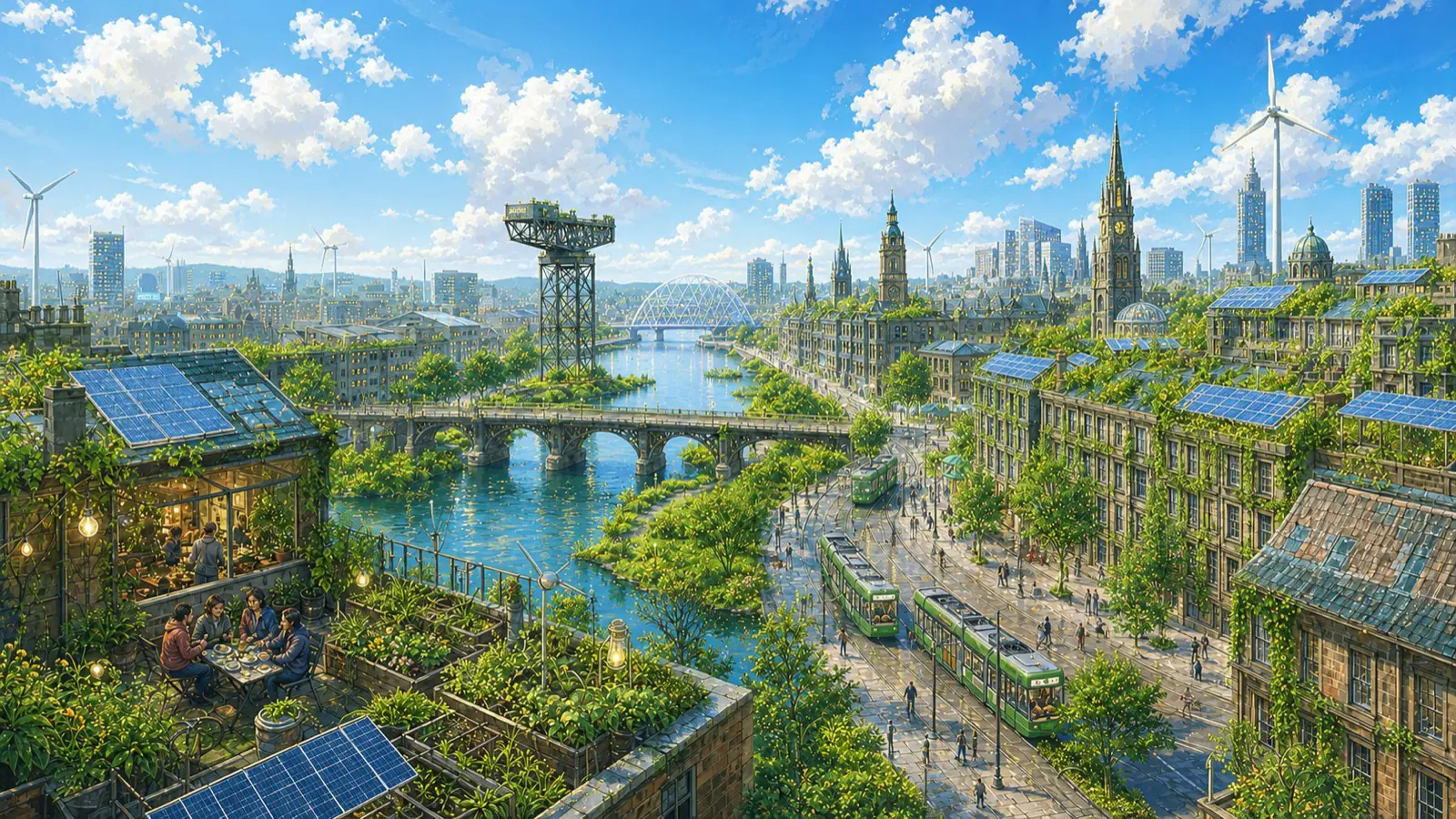

The Solarpunk Society · Part One · Chapter 3
Our First Great Clan Gathering
The Big Blether Get-Tae-Gither revealed on all levels, metrics and data points that we were collectively done with the left/right pantomime. The divisive political distraction show was ready for the bin and we were ready to build something new. After the raves were over and the real work of our Interdependence began, we discovered that debating chambers make for shite dancefloors. There’s just no flow. No vibes, maaaan.
Debating chambers in parliaments are living embodiments of that left/right divide the cult wants us to believe is some fundamental part of politics. If you’re over on the right wing of the chamber and you’re feeling the vibe of the folk kicking off on the left, good luck making your way over to join them without any obstacles. It’s all pews and partitions, tribal sections for different teams, incomplete circles and segmented spaces.
Imagine heading out for a night, alone or with your crew of mates. The best nights are when you cross-pollinate with new weirdos and different tribes. Dancefloors designed well can help with that. They dissolve protective egos and a magical non-verbal unity can emerge under the right circumstances. Debating chambers, on the other hand, are about as stiff and rigid as an Eton boy’s cum sock. I know, it’s an odd place to start when talking about the founding principles of a post-capitalist ecological society. But it’s no more ridiculous an obsession than a saggy old man, sprayed the colour of a rusting traffic cone, getting all ‘woke’ and reassigning the Gulf of Mexico.1
We didn’t know how to run our own country properly in those early days post-2018 over on my timeline after the month-long rave brought down the government. Contrary to dystopian blockbuster scripts, we didn’t decompose into the political vacuum, wake up as zombies and start eating each other’s children. With no clear emerging leadership, we mostly just gathered. We blethered. We turned to one another – not just outside the Parliament but back in our villages, towns and cities for what became known as the Big Blether Get-Tae-Gither.
No one person organised it. The national Big Blether sprouted everywhere, seemingly all at once: town halls, abandoned churches, school gyms, forest clearings, roof gardens, skate parks and Zoom calls from community centres. There were people who emerged as natural connectors, joining up the results of all these meetings into something useful on a national level. Some others obviously turned up just to cathartically shout, some to cry, some to hand out food to hungry mouths. But what mattered was that we all showed up – as neighbours and equals, not just anonymous avatars behind screens.
I remember my first Big Blether in a drafty church hall in Springburn. The air smelt thickly of homemade lentil soup like yer grannie used to make, along with that awful smell of wet duffle coats. A 17-year-old lass stood up, her voice trembling as she plucked the courage to propose forming a group she called ‘The Clan of the Quiet Ones’ – a kinship for the introverts who usually get shouted over by loudmouths. There was a resoundingly quiet excitement around the room for such a random suggestion.
It’s true there were a few trolls who turned up out of some anticipated schadenfreude but actually, many of those early cynics ended up being the most important contributors to many niche discussions. One such taxi driver (let’s admit it, we assumed he was a bit racist and bigoted at first, which itself was a bit of a bigoted assumption about taxi drivers) ended up being an epic resource, helping a group of local muslim women map out the entire city and its areas of highest deprivation most in need of child support.
The discussions and solutions that surfaced were rarely revolutionary or sexy on paper. People were willing to accept short-term pain for longer-term success, it turned out. What united us in optimism – despite the chaos all around – was a future vision that wasn’t on fire. It was goals like community safety, access to food, water and meaningful paid work, personal dignity, time to experiment, create and grow. We wanted to be warm in winter, make music and enjoy art. Simple things. Sacred things. The stuff no government manifesto ever seems to mention anymore and, if they do, they are conveniently forgotten or ‘unaffordable’ upon taking office. Somehow, there is always money for random wars and politician duck house expenses though.
When the lid was lifted, it started to dawn on most of us that if we stopped clutching our daft wee flags and sectarian team scarves for a minute, we had a lot more in common than we were ever meant to realise. We’re Scottish – not Irish, British, Israeli or Palestinian. Their struggles may inform us but they do not define us. The old divide-and-conquer sectarian lines, all that Protestant-versus-Catholic pish, started to fade as soon as most of the institutions propping up the hatred fucked off to England after our month-long rave.
It wasn’t all polite, though. In the early days of the Parliament raves, a gang of Orange Order2 British-flag wavers turned up to terrorise and start fights. The police had conveniently stepped down from their posts that day, too. The group of armed cowards gathered under a tunnel (like actual trolls) and began planning how to cause the most amount of fear and damage possible. In the end, they chose to sneak in from the side and charge at our children’s creche area, thinking that would be the weakest spot and send us all running. The knuckle in their collective head had failed to comprehend the hidden well of determination of a group of mothers and fathers whose children were suddenly under threat. As the Orange Order thugs charged, revealing their intent to harm, several mums, well-practised in this game by now, lifted the parachute that had been on the ground for the kids’ games and, in one swift motion, collapsed it over the entire gang – British flags and all. The rest of the dads and mums then stood on the parachute edges, while the kids looked confused (but not traumatised) by this weird-ass group of adults coming to play. Underneath, there were so many sectarian slurs being thrown around that the noise made by the bigot butcher band attracted the rest of the unsuspecting ravers. More and more rushed over to help, encircling the surprisingly thick parachute. Those and some old slacklines lying about were perfect for wrapping around the now-trapped and blinded invaders if need be.
When they finally calmed down, we slowly lifted the parachute from their heads. On noticing they were surrounded in row after row of smiling but laser-focused adults, all staring at them, there was a long, awkward silence. My mate DRIFT finally broke it when he offered a sweaty, terrified and dehydrated-looking bald man a bottle of water and a sip of his tea flask. The guy cautiously accepted the gift and the high five that followed it. Some Scottish grannies made their way to the front of the tense circle, too, and had a wee word in the ear of many of the intruders. No one likes a telling-off from granny and, as we Scots know, ye cannae talk back and ye cannae throw them aff a bus. Eventually, as tensions calmed, most accepted the escort back to the train station. Those who stayed behind did so not to cause more trouble but for medical assistance, a bowl of soup or even a wee dance. Hard to stay angry for long with good music!
The power of such a deep and rapid culture shift isn’t fantasy, nor is it unprecedented. The early 1990s rave scene across Scotland and England practically wiped out football hooliganism. It brought about an almost overnight shift in culture, music and drug of choice that saw previously drunk lads who’d glass each other suddenly hugging in random fields the following weekend, high on pills and pure vibrations. Who knew that the solution to ending centuries of sectarianism was as straightforward as following our newly emerging Scottish golden rule:
DON’T BE A CUNT.
Fast forward to the Big Blether again and – despite the decrease in sectarian violence – there was still no great central unifying ideology that came out of the findings, no single ‘ism’ that defined everyone or our shared vision. It seemed, in many ways, what we were building was post-ideological (but certainly not apolitical). Maybe because our evolving movement was not stained with the blood of a million deaths in the name of some revolution, our hearts hadn’t been hardened, nor had collective PTSD forced us into illogical binaries of heroes and traitors. After the Big Blether, we realised that trying to lump everyone into one homogenised whole – trying to be everything to everyone – just gave us a grey-brown clump of crusted playdough that was nothing to no one. Despite what economists had told us for decades, there is no such thing as Homo economicus (the average rational actor, as they call it). Trying to sum up the totality of the human experience into one boring average cunt is just daft folly. Our diversity, it transpired, is the source of our collective strength, not something to be tolerated or battled against; and if we were to find a way forward, especially in such a timely crisis, we needed to rebuild around our diversity, not opposed to it. That is how the new Scottish clan structure emerged – organically across the country, not tied to geography or the family you were born into, but as open clans of choice. These new clans weren’t rose-tinted hark-backs to outdated forms of family alliances, marrying off daughters in return for sheep. There were no Clan McFucknoses murdering the MacSneeziepits in their sleep in Glencoe. These new clans were new kinds of kinships forming in a vacuum with just enough creativity and chaos to make them an interesting fit for the modern world, but infused with enough culture and tradition to rally most people behind them.
Sometimes, they were indeed formed around geographical locations as well as physical communities, sometimes around temporary projects, sometimes just shared vibes and interests. You could be in as many clans as you wanted – or none at all (though most people chose membership of at least one). Apathy rather than participation became the anathema in a period of such radical possibility and people power. Some clans focused on solving practical challenges like community energy, land stewardship or public transport. Others were playful, like the aforementioned Clan of Quiet Ones for the introverts and spectrum folk, the Techno Druids for the weird ravers or the Order of the Massive Cuppa for those who loved a cosy couch. I initially joined the latter two but got kicked out the Massive Cuppa because I was too wired on coffee. Lest you think this is just another recipe for the bigger clans to bully the small ones for power, we built in a few catches. For example, membership wasn’t just a headcount numbers game. Only members with active participation points awarded to them by other members were included in a clan’s eligible membership for elections. More on all that later.
The early clan formations with very little to support them were forced to pool resources and share tools, building ties of mutual growth and aid while creating the conditions for new clans and communities to form and join the web. The point wasn’t to build from scratch but to reuse and repurpose the state-owned stuff we’d inherited from the collapse. Even more important than the practical organising of the early clans was that they gave folk a way to belong again – not just as represented citizens but as empowered co-creators with a clear mission. This was the clan network’s superpower. Aye, there was a bit of friendly rivalry between some, but on the whole, it brought everyone from all the mad backgrounds together through a shared commons. If the goths were birch trees and the golfers were pines, then the clan network was the mycelia connecting them under the surface, pooling resources as well as sharing much needed common understanding. Free from the cult, empire and sham parliamentary democracies, it felt like a natural progression for us to begin to build our alternative system on something both ancient and radically new at the same time.
The stage was set for the very first Great Clan Gathering in hundreds of years in Scotland. Every clan would have the right to send representatives relative to their size as well as bring ideas to the table – a literal table placed in the middle, built from driftwood and wind-felled oak. As I speak, this table has been hauled from town to town for many of the Big Blethers and has become the focal point for the weirdest, most wonderful collective reimaginings Scotland has ever seen. Some early ideas failed spectacularly. Others exploded in glory. But all of it moved us away from capitalist fatalism and toward something fresh and really fucking exciting – something rooted, playful, grounded and suitably strange. It felt alive.
That’s what this book truly is, too: not a dead manifesto, not a list of 23 magic answers we came up with to solve every world crisis you might possibly be facing in your community or country, but a glimpse of what happens when you stop waiting for someone else to save the world and just get stuck in!
The Great Clan Gathering was announced just in the nick of time because, despite the Big Blether excitement, the financial pressure was on. Since the old government and the entire parliamentary system had collapsed in on itself, most government employees were left without a system in place to pay them anymore, yet they had continued to go to work – well, people who worked in essential community jobs, like refuse workers, social carers, doctors, teachers and the like. Anyone in a meaningless admin job jumped at the chance to leave and enjoy a much needed rest during the unfolding chaos. Many also banded together to volunteer and help keep essential public services functional while we, as a nation, worked out what the fuck we were going to do next. This banding together to keep things going might, in fact, have helped the early clan structure to emerge, giving it much needed kindling.
Many are under the illusion that, if the government shuts down, the whole of society would fall apart instantly. But as the US has shown time and time again in recent years, while government shutdowns are bad, they are not as disastrous as you would imagine. It’s more of a slow burn. Companies continue to function, shops stay open, parcels get delivered and farmers keep growing food. In our case, volunteers banded together to shore up struggling public services for a few months.
Luckily still, we managed to hold our first Great Clan Gathering only six months after the fall of Parliament. That’s when our second attempt at real independence – our Interdependence – began. Not a moment too soon so families could get paid again. There was nationwide support for the Gathering and high expectations for something radically new to come out of it, especially from those who were working their arses off for free in the belief their temporary pain and sacrifice would lead to something better for us all.
1. Is the renamed Gulf of America a trans gulf now? How about the trans US Department of Defence that now identifies as the Department of War?
2. The Orange Order is a shadowy organisation established in Scotland by the English, designed to drive a sectarian wedge into Scottish culture. They have a history of violence and hatred, marching every year in celebration of an ancient battle they have co-opted to mean the killing of Catholics. Obviously, they should have been banned decades ago, but the British state needs their proxies to keep the people in their colonies divided and therefore conquered.