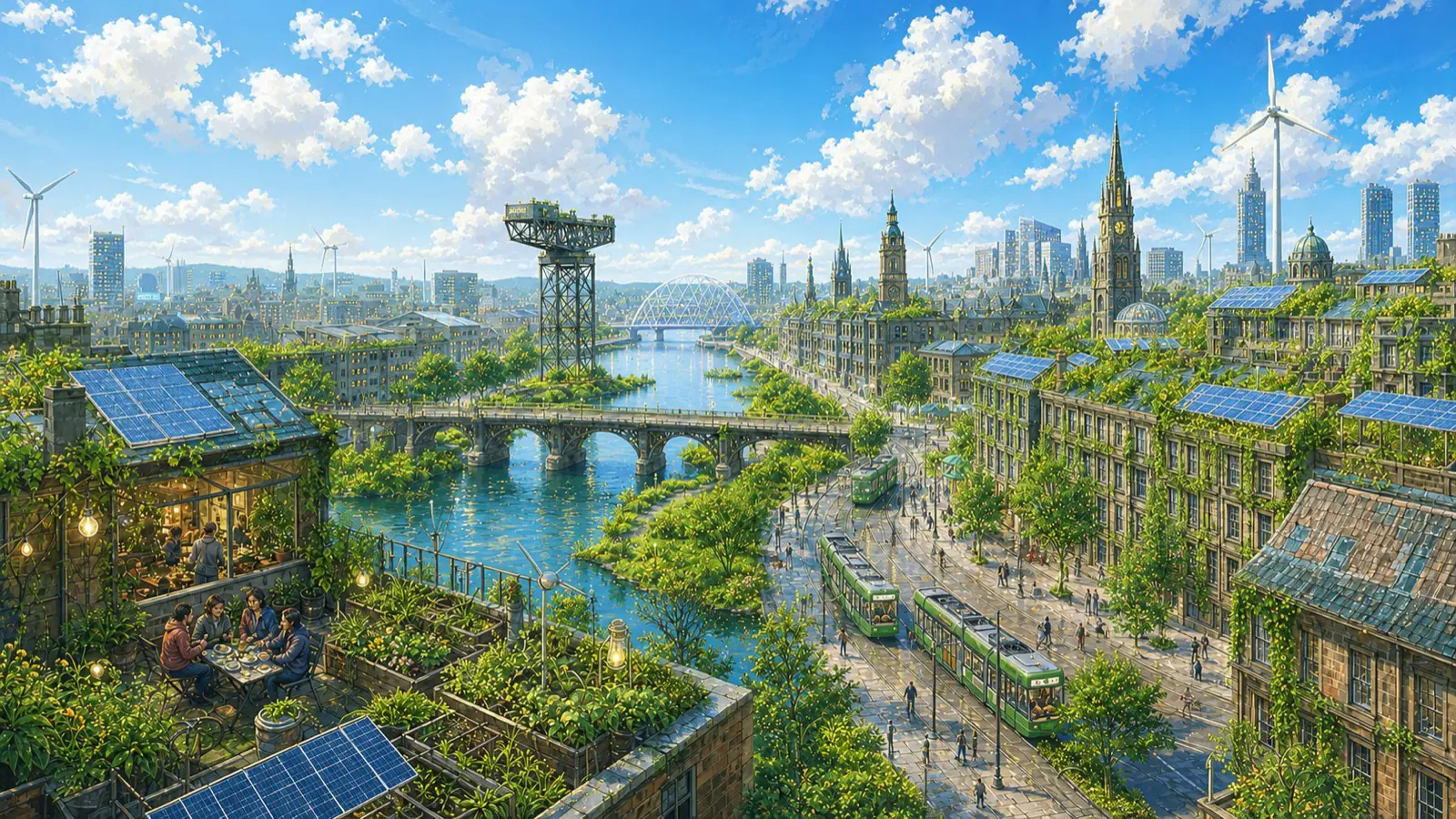

The Solarpunk Society · Part One · Chapter 9
Non-Violence Does Not Equal Passivism
We are living in the Anthropocene – the era of the Sixth Mass Extinction – precisely where evolutionary forces kick into overdrive. Driven not by comfort but by the sheer necessity to survive, old dinosaur ways rapidly die off while specialised niches rise to fill the new paradigm space with systems better adapted and more resilient. The actual revolutions that define the transitional space between old and new can be messy and violent though, as the old system clings on for dear life, like an old bull roaring one last time before running out of air.
Solartime Scotland, however, is a testament to the fact that violence is not a necessary prerequisite for change to occur, despite its ever-lingering threat. Quite the opposite: Solarpunk is the epitome of non-violence. It is a system founded on trust, mutual benefit and radical diversity.
Here in Cybertime, for those of us living under a sudden surge of intolerance, bigotry and force, it’s easy to mistake it for a resurgence in the power and dominance of the old cult’s ways. Any thin, tokenistic veneers of civic rights and egalitarianism are rapidly stripped away as the cult retreats into the only force it knows: violence. This is not a sign of systemic strength or vitality – it is the exact opposite. Someone lashing out in ever-increasing aggression must feel weak and under existential threat on some level, hence their need to puff their chest. As the evolution of life has shown us, these violent outbursts often precede and mark the beginning of a profound change in direction. It’s a wholesale dying-off of the old guard, creating open space for better-adapted systems to expand into.
Yet, we can’t simply hide under rocks and hope the old bull puts itself out of its misery. We need to actively have conversations, build rallies and organise international actions led by unifying beliefs in a better world – the world the fearful old bull senses is coming. We need to start talking about that better world more publicly and with each other because without a better world worth fighting for, why would anyone risk their skin in the game?
The up-class (the so-called extreme right) has its nihilistic story mapped out, bankrolled by billionaires who know they need fascist foot soldiers on the ground to back up a well-funded narrative. This narrative offers desperate, ignorant people the scapegoats they need to be distracted with blind hate, allowing the billionaires to continue their theft. As the ‘moderate’ bureaucratic capitalists collapse inwards under the weight of their own unpopularity, the rich know people will move towards radical politics and, if the public doesn’t choose fear and fascism, they will be coming for the billionaires instead.
Meanwhile, the down-class (the so-called left) is constantly being cancelled, deplatformed and defunded. Now, here in Cybertime in 2025, we are witnessing the mass criminalisation of all dissent. Harmless protesters – 80-year-old grannies in England who dare to speak out against the genocide in Palestine – are being thrown in jail as terrorists. Immigrants are being disappeared to secret foreign prisons. Trans people are being systematically denied access to public life (toilets, schools, healthcare) through manufactured bad-faith debates. History shows us fascism doesn’t plateau its violence or slows down in response to public unpopularity. Unless completely smashed and eradicated, we know what the next phase of the plan is – and at that point, it becomes a vastly more bloody and painful task to root out the disease. We have to start building our new world now, out of the already crumbling remains of this fascist Cyberpunk Big C Cult before it all gets turned into radioactive rubble.
The reason fascist rhetoric is so alluring initially, even to working-class people who have the most to lose, is that its fears and scapegoats speak directly to our most primal circuits of consciousness. Fascism targets the first, or motherly, circuit of consciousness – that is, the mammalian desire for the state or a strong leader to provide safety and sustenance. Once the fascists convince us we are existentially unsafe which, after decades of the late-stage Big C Cult, many can agree with – their strength lies in the simplicity of their target, reducing the threat down to blaming our neighbours who look the most different from us. This doesn’t work on any intellectual or spiritual level, but it hits home on our second, territorial (or anal) circuit of consciousness:
‘My tribe good; other tribe bad! I am top dog; they are bottom.’
Which explains why those with a heavy imprint of this patriarchal circuit seem so cognitively dissonant – especially when challenged on the perceived criminality of, say, immigrants versus the very real, convicted criminality of their leaders. Their gaze of hatred is always downward, towards those they perceive to be below them. They feel it is their moral duty to bite down on those beneath them to establish their status in the pack, while happily handing over privileges and get-out-of-jail-free cards to those they deem above them – the super top dogs (ahem, TRUMP).
My Solartime proves nothing is inevitable, but the lesson in times of great instability and fear is that we cannot ignore people’s primal concerns. We can’t ignore their desire for a motherly embrace bringing them safety. The political left who assume the position of representing us doon-folk are frequently dog shit at this task, snarling from the sidelines in the hope it will change the world. They are often too obsessed with shaming people who don’t use the right language, over-intellectualising or promoting middle-class elites who lack experience of real struggle. They would rather debate the intricacies of late-stage capitalism than rally and unify the people they claim to represent.
However, there is new hope in those who are finally catching on to this act – the New York Mamdanis and British Green Party Polanskis of the emerging world, who talk about the fear we are all feeling while bringing the conversation back to the fundamental economic issues. It is yet to be seen if they, too, are turncoats as soon as they transfer from the doon-class to the up, but, at least for now, they are attempting to address what affects us all – our first-circuit sense of safety and our second-circuit sense of control and empowerment.
‘All right, but apart from the sanitation, medicine, education, wine, public order, irrigation, roads, the-fresh water system and public health, what have the Romans ever done for us?’— From the film ‘Monty Python’s Life of Brian’ (1979)
This has all happened before. It has the same stench other rotting empires once had. Let’s geek out on the Romans for a moment. Their empire, in its later stages, became a casualty of its own colossal scale and ingrained imperial narcissism. It had expanded far beyond sustainable limits, creating a bloated bureaucracy and a costly military that ceaselessly drained resources to hold vast territories – rather than investing in internal infrastructure, food and vital innovation. For generations, military expansion was the ultimate display of power for the increasingly egomaniacal emperors. The problem with having an empire stretching halfway around the world – as anyone who served in Iraq will tell you – isn’t conquering it but maintaining the peace after.
This pervasive ego born from an empire too arrogant to critically self-assess and evolve ultimately rendered it too rigid and inefficient to withstand complex challenges. The ruling elite, proud and set in their opulent ways, remained detached from pressing systemic issues like economic inequality, rampant corruption and declining civic engagement. Foreign invaders found it easy to take advantage of this internal decay. They, however, were not the primary drivers of its collapse. It was the already rotting system which, at its core, stemmed from the ruling elites’ detachment from the needs of the citizens and the calculated protection of their own wealth.
The rich were exempt from serious taxation so, to fund the massive, overstretched military, emperors had to systematically debase their currency year after year. The silver content of the denarius was reduced to near-worthless levels, essentially stealing from everyone’s savings to pay for the empire’s debt. This recklessness triggered runaway hyperinflation, hollowing out the cities, destroying entire trade routes and bankrupting the middle-class merchants and artisans who were once the economic backbone of the empire. If you happen to live in the US in Cybertime 2025, does any of this sound familiar?
Simultaneously, the wealthy senatorial class expertly used their influence to further evade taxes, leaving the crippling burden of maintaining a state entirely on the poor, while sending their children into meaningless wars for the whims of their supposed leaders. Civic administrators were forced to flee their essential posts, causing the state to lose both its functionality and its pool of loyal leadership, leaving it utterly dependent on unreliable, federated barbarian mercenaries (foederati).
This combination of economic instability, civic decay and military dependency – all stemming from an arrogant elite prioritising short-term financial self-interest over citizens’ well-being – made the empire too fragile to withstand the inevitable external pressures.
Some territories previously conquered by the Romans were simply so hollowed out and shattered that, when the Romans withdrew, society collapsed. The power vacuum led to a catastrophic loss of knowledge and scale, with the technological regression most acutely felt in the crumbling of vast public infrastructure. Highly engineered aqueducts and sewage systems failed, leading to a sharp decline in public health and massive population shrinkage. The sophisticated network of Roman roads dissolved, halting long-distance trade and forcing communities into isolated, backward subsistence farming. The world lost its advanced blueprints – from how to build durable roads to how to maintain clean cities. The devastating setback took centuries to recover as the void was filled by warlords and religious superstition.
So once again, if we are witnessing the collapse of public infrastructure, health, science and global trade – amplified by rising local protectionism, nationalism and tariffs – we are witnessing the effects of a collapsing empire. Human progress, just like evolution, doesn’t follow a smooth upward curve; it is fraught with pits and spikes.
American Imperialism, much like the late-stage Roman Empire, has been the most persistent blockage of human progress since WWII. Especially since the fall of the Berlin Wall in 1989, US foreign policy has been that big tuft of rancid hair, oil, fat, screws and coins blocking the universal shit pipe, forcing global progress to back up and fester in stagnant, commodified water.
This was acutely evident when the US prioritised the short-term profit of its pharmaceutical giants over the lives of millions by championing the TRIPS Agreement. This move suppressed the production of affordable, generic antiretrovirals during the AIDS crisis, effectively stalling global progress in infectious disease management for years and leaving millions of ‘untouchables’ to die horrifically in pain. Gay men’s and poor Africans’ welfare, it seems, didn’t matter much to the US government. Concurrently, US-led institutions like the IMF and World Bank conditioned debt relief on harsh Structural Adjustment Programs (SAPs), forcing developing nations to cut social spending and privatise essential services, reversing decades of progress and locking vulnerable economies into perpetual debt cycles. Instead of launching a unified global effort to alleviate human misery, the US weaponised its unchecked dominance to further entrench a self-serving economic order.
This imperial arrogance extended to stalling technological shifts that threatened established profit models. The US automotive industry actively resisted and recalled pioneering electric models like the EV1 throughout the 1990s, successfully lobbying to protect the fossil-fuel economy and delaying critical climate change mitigation progress by over two decades. Those twenty years could make the difference between our entire species living or dying.
Geopolitically, the US has consistently preferred economic control and hegemony, backing and arming dictators, death squads and fascist strongmen so long as they swear allegiance to Washington first – and allow in a military base or two. Many well-researched works have been written about how truly awful the US empire has been for the planet and its people.1 My point isn’t to revise this familiar history but to point out that, throughout this unfolding catastrophe that feels so disempowering, there are always moments of incredible opportunity too – depending on how we act.
When USAID got completely gutted by the billionaires of the US oligarchy under Trump 2.0, it was such a moment. It was potentially perfect for a timeline split to occur. USAID was never meant to be a humanitarian charity. For decades, it was used as a political tool in the spreading of American hegemony, creating crippling economic codependency on the United States, its corporations and shell fronts like the IMF and World Bank. It obliterated the internal food markets of agrarian countries by flooding them with cheap American corn and US surplus, destroying local farmers’ incomes. It was all done under the banner of ‘aid’. With markets suitably interfered with, it was much easier for the IMF and World Bank to now force countries into huge unpayable loans, giving them leverage for the ultimate outcome – imposing the production of cash crops or raw material extraction, none of which was for the locals to use. Even in the midst of disasters and famines, local farmers and workers would be forced to produce food products and raw materials for US-led companies, shipped overseas right away while they starved to death. This deliberate codependency gave the IMF and World Bank leverage (so-called soft power) over the lives of entire countries if they dared rebel against doctrinal policy. The underlying threat was simple: Comply and we will feed you a subsistence amount from our rotting surpluses; rise up and we will starve you to death.
When USAID collapsed, turned off with brute force at the hands of a pair of daddy-boy fuckwits,2 the sudden shutdown could have been an incredible opportunity for oppressed economies and emerging markets to empower local producers with the capital they had been robbed of and for global NGOs, now free from American control, to finally tackle the root causes of poverty and hunger. But that hasn’t happened. Why? Why was no one prepared to take advantage of this chaos, other than the arseholes causing it? BECAUSE NO ONE HAS ANY WORLD-BUILDING VISIONS ANYMORE! We only envisage a myriad of dystopias, fetishising the ‘inevitable’ apocalypse we often seem to accidentally cheerlead into existence. This lack of alternative world-building, unfortunately, means there are probably millions more poor, dependent people suffering and dying today in the aftermath of the USAID shutdown. It’s like a narcissistic partner suddenly dumping their victim at the side of a desert road after years of manipulation and coercive control. Yes, the victim is now finally free of their abuser, but they are also without financial means, stranded in a place that lacks basic life-supporting infrastructure. Worst of all, the resource-depleted vacuum left behind will eventually be filled by whoever has the most abundantly ready plan – which, by the looks of it right now, means China stepping in. It is the geopolitical equivalent of replacing a lying, narcissistic partner with a cold, controlling authoritarian one, when all the victim ever wanted was to be left to their own devices, with restored access to the resources stolen from them.
There has never been a more pertinent and important fucking time for us to build an alternative vision free from autocrats, authoritarianism and blood-sucking corporations. We shouldn’t settle for the claustrophobic ‘realism’ that our only hope is to be passed between evil superpowers like a poor seal between two killer whales.3 When we formed the Solarpunk society on my timeline, we were lucky to evolve into one of those progressive evolutionary spikes, rather than a dark age like the one that followed the fall of the Roman Empire. Our new, emerging society is not a techno-utopia saved by some magical, futuristic technology you don’t yet have here in Cybertime. On the whole, we just radically reshaped existing systems into a vastly improved model that can adapt at the pace necessary to keep up with an increasingly evolving world. We did this using whatever we had lying around. Our goal is intersectional synchronisation and long-term sustainability, not short-term conquest, domination and exploitation. Essentially, all our systems and processes are underpinned by a new universal directive – a directive we place at the top of all official documents. Citizens have even put up big neon signs on top of the highest peaks in many Scottish cities, beaming through the grey clouds at night:
DON’T BE A CUNT.
1. For some political history, I recommend reading any of Noam Chomsky’s political writing or John Pilger’s journalistic work which spans essays, books and documentaries.
2. The exact motives behind the USAID shutdown remain unknown. It could have been an ignoramus’ way of cutting state spending with a blunt scythe, part of a wider agenda to fracture global hegemony or direct retaliation for USAID’s investigations into Elon’s businesses.
3. This is a real-life scene from David Attenborough’s The Trials of Life series that describes an orca behaviour known as ‘porpoising’. Interestingly, it has recently been observed that humpback whales help seals and other prey escape the seemingly malicious orcas and their torture play. Orcas often kill the babies of other whales, so this might be their retribution or justice.